
Business financial model file
Dog Grooming Studio Financial Model
Separate a grooming salon's wet-area investment from the contribution and usable appointment time of each completed groom.

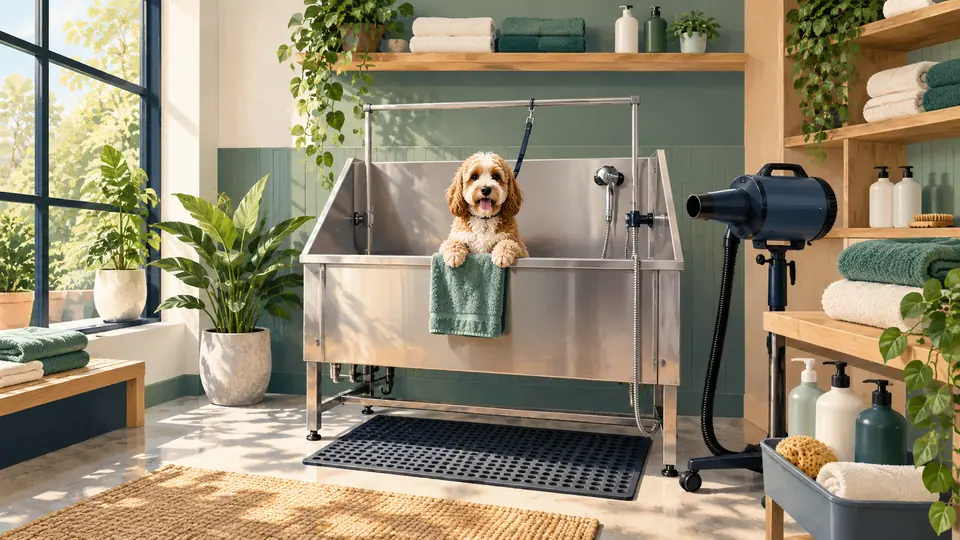
Opening investment and working cash
The original two-groomer setup includes plumbing, ventilation and drying equipment rather than only clipper purchases. No boarding or veterinary service is included. Actual site/care requirements and equipment capacity must be verified before relying on the cash allowances.
| Cash use | $ |
|---|---|
| CAPEX: Bath/drying equipment | 18,000 |
| CAPEX: Plumbing/ventilation and premises fit-out | 25,000 |
| CAPEX: Grooming tools and POS | 7,000 |
| Pre-opening: Local setup, training and launch | 6,000 |
| Refundable deposit / tied-up cash | 5,000 |
| Opening stock / initial working inputs | 1,500 |
| Reserve: 2 selected fixed-cost months | 29,436 |
| Selected opening cash total | 91,936 |
CAPEX totals $50,000, pre-opening expense $6,000 and working cash $35,936. The deposit and opening stock tie up cash; they are not added again as monthly rent or consumed inputs. The reserve is a chosen fixed-cost buffer, not proof of full funding. Obtain actual installed/tax-inclusive quotes and dated opening payments.
Monthly fixed and variable OPEX
Groomer wages assume $22/hour and front-desk $20/hour, with an original 20% employer allowance. The fixed laundry service differs from the incremental$3 appointment usage. A longer coat, difficult handling or a second handler can change both labor and appointment time.
| Commitment | $ per month |
|---|---|
| Two groomers: loaded 160-hour rosters | 8,448 |
| Front-desk coordination: loaded 80-hour roster | 1,920 |
| Rent/common charges | 2,500 |
| Base utilities | 400 |
| Insurance | 350 |
| Scheduling/software | 150 |
| Base laundry service | 200 |
| Maintenance | 200 |
| Marketing | 350 |
| Admin/fees | 200 |
| Total selected fixed cash | 14,718 |
| Item | $ per unit |
|---|---|
| Net collected selling value | 90 |
| Shampoo/consumables per appointment | 8 |
| Incremental laundry per appointment | 3 |
| Percentage-only fee allocation (3%) | 2.7 |
| Contribution before scheduled payroll/fixed OPEX | 76.3 |
The percentage fee is an aggregate allocation, with no fixed per-payment charge assumed. Unit contribution is not owner income: the full listed monthly roster and overhead still need coverage.
Capacity, break-even and a lower-sales case
Two groomers provide 320 combined paid hours; at 75% productive time that permits 240 one-hour comparable appointments. Bath/drying availability restricts the selected calendar to 220; planned volume is 210. This is a scheduling assumption, not a certified animal-care or occupancy limit.
For this fixed mix and commitment, whole-unit cash break-even is 193 completed standard grooming appointments per month: ($14,718) ÷ $76.3, rounded up. The aggregate capacity is 220 units; it does not establish customer demand or a workable daily sequence.
| Paid units | Net sales $ | Selected result $ |
|---|---|---|
| 160 | 14,400 | -2,510 |
| 193 | 17,370 | 7.90 |
| 210 (planned) | 18,900 | 1,305 |
| 220 | 19,800 | 2,068 |
At 160 appointments the roster and wet-area premises remain paid. Confirm customer repeat cycles and the bath/dry bottleneck before adding another groomer; the retained guide example has a different incremental scope.
Practical KPI definitions
Track completed appointments and net service value by coat/service class, actual groomer minutes and no-shows separately. Contribution per available groomer hour must include unfilled slots; an animal waiting to dry is not another completed groom.
Sales exclude sales tax. Refunds, care incidents, finance, income tax and replacement equipment are not quantified; monthly supplies are replenished and payments align for this case.
Method context: SBA business planning. All case prices, wages, cost ratios, reserve and capacity inputs above are original planning assumptions.
What the model covers
The official FinModelsLab listing describes visits per day, operating days, category prices and sales mix, with add-on and retail income per visit. Inputs also cover supplies, fixed expenses, salary and staffing plans, and dated capital purchases. Stated outputs include profit and loss, cash forecasts, break-even analysis and dashboard charts.
Use the offer that creates new contribution
Our assumed salon earns $360 from 24 full-price appointments. Four new discounted visits in spare capacity raise that to $480. Discounting all 28 visits instead leaves only $240. Both larger diaries use the same hours, but the pricing decisions differ.
Use service-specific durations and safe appointment limits before raising daily visits. Target genuine gaps and measure how many full-price bookings the offer displaces. The Dog Grooming Studio planning guide develops the original worked case.
Planning guide