
Business planning guide
Trucking Plan: Which Load Pays More for the Whole Truck-Day?
Choose freight work from complete trip contribution, occupied truck-days and collection timing.

On this page
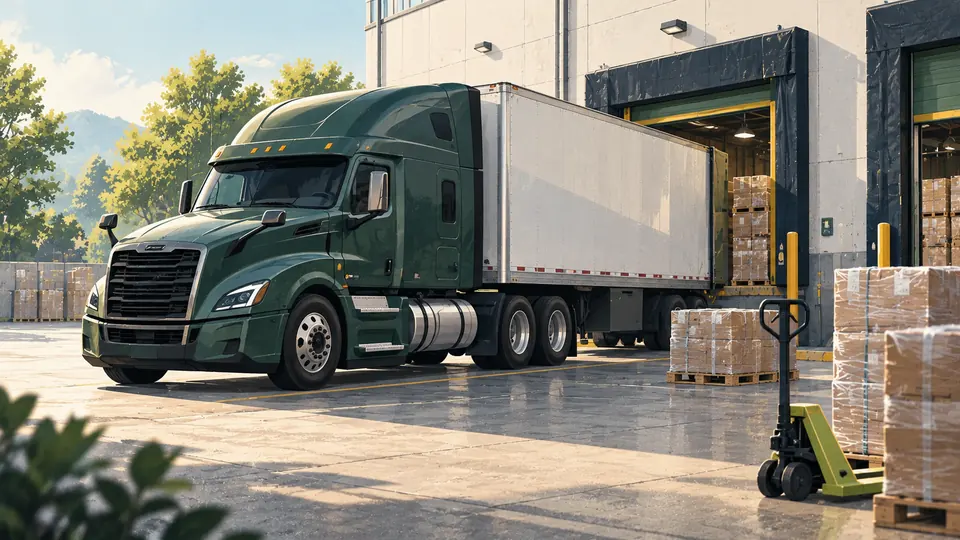
Compare freight work over the complete truck calendar. Loaded-mile price omits empty positioning, waiting and the time before another load can begin; those costs can reverse which quote is attractive.
Use all driven miles in cost
Original assumptions, $ per trip. Trip A pays $3 per loaded mile over 1,000 loaded miles and adds 250 empty miles. Trip B pays $2.80 per loaded mile over 900 loaded miles and adds 50 empty miles. Variable vehicle/driver cost is $1.60 per total mile. Other waiting/trip costs are $500 for A and $200 for B.
| Measure | Trip A | Trip B |
|---|---|---|
| Revenue | 3,000 | 2,520 |
| All-mile variable cost | 2,000 | 1,520 |
| Other trip cost | 500 | 200 |
| Contribution | 500 | 800 |
| Truck-days occupied | 5 | 4 |
| Contribution per occupied day | 100 | 200 |
The lower loaded-mile quote produces twice the contribution per occupied truck-day under these assumptions. At twenty usable days, four identical A trips contribute $2,000 while five B trips contribute $4,000 before standing fleet costs. Those are capacity cases, not confirmed back-to-back bookings.
Find the rate needed to match the alternative
To match B's $200 contribution per occupied day, the five-day A trip would need $1,000 contribution. Its selected costs are $2,500, so revenue must reach $3,500, or $3.50 per loaded mile. That threshold assumes the same mileage and occupied days; it does not establish the customer will pay it.
Fund the trip before collection
If selected costs are paid before day 30 customer collection, A needs $2,500 and B $1,720 before their respective receipts. Add standing fleet, debt, repairs and other overlapping loads on actual dates. Factoring changes timing only under its actual fees, recourse and approval terms.
Verify positioning, loading windows, driver availability and applicable operating constraints independently. The selected Trucking Financial Model is the seller's Trucking Service model and builds service-unit volumes, rates, costs and fleet investment into the broader forecast.
Scope & limitations
Original route patterns and costs, not a freight-rate or legal driver-hours benchmark. Actual routing, load availability and driver feasibility require review.
Explore available financial tools