
Business planning guide
Food Truck Plan: Will the Event Sell the Food Prepared?
Choose event purchasing and attendance using credible served orders and the cost of unsold preparation.

On this page
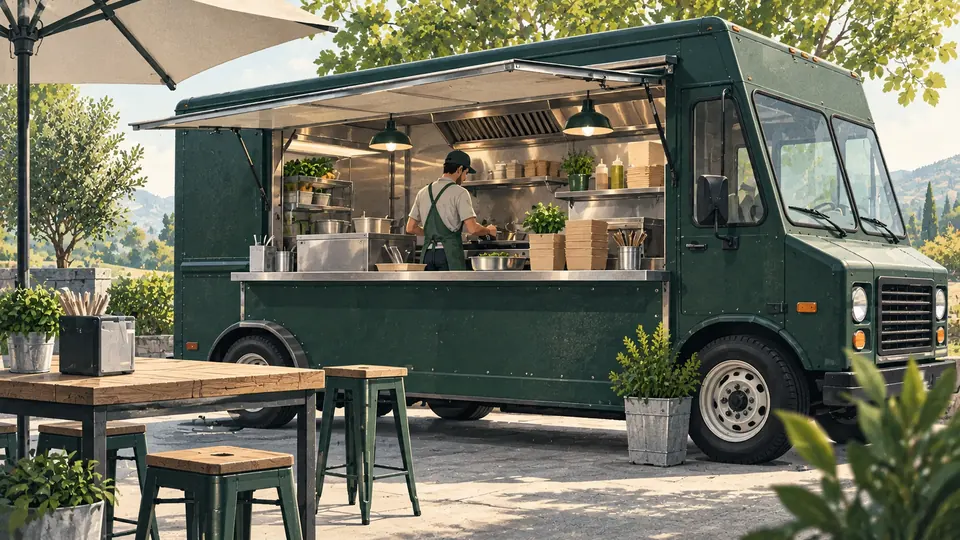
An event should be costed from what must be prepared and paid for, not only what is eventually sold. A large crowd cannot buy more than the truck can serve, and unsold prepared food may already have consumed cash.
Separate ingredients prepared from packaging used
Original assumptions, $ per event. The truck prepares 220 comparable portions at $4 ingredients each, costing $880. Packaging costs $2 per served order. Each order sells for $14. Event fees, travel, setup and shift labor total $1,300. A four-hour window at an assumed 55 completed orders per hour caps service at 220 orders. Unsold prepared ingredients have no recovery value in this case.
| Orders served | 140 | 180 | 220 |
|---|---|---|---|
| Sales | 1,960 | 2,520 | 3,080 |
| Ingredients prepared | 880 | 880 | 880 |
| Packaging used | 280 | 360 | 440 |
| Result after event commitment | -500 | -20 | 460 |
At 180 orders, forty unsold portions contain $160 of ingredients. Treating all ingredients as $4 per served order would omit that spending and overstate the result by $160. It is already in the $880 batch cost; do not deduct the waste twice.
Find the threshold for this prepared batch
After preparation, each additional served order brings $12 before the fixed batch and event commitment. The threshold is (880 +1,300) / (14 -2) =181.67, requiring 182 whole orders. At 181 the result is negative $8; at 182 it is positive $4. A different batch quantity or menu mix needs a new calculation.
If ingredients and event commitments are paid before service and packaging before day 2 settlement, the 180-order case needs $2,540 before $2,520 receipts arrive. The final $20 loss does not describe the much larger funding requirement.
Use tested service timing, written site/cancellation terms and credible order demand to select purchasing. Keep truck ownership, financing and other trading days in the whole-business plan. The Food Truck Financial Model links cover/check assumptions, staffing, costs and investment in the broader forecast.
Scope & limitations
One assumed event, fixed prepared batch and comparable orders. Actual menu yields, safe food practices, event terms, fees and throughput need verification.
Explore available financial tools